Towering Over Time: Why Kareem Abdul-Jabbar Still Matters in the GOAT Conversation

In the glittering pantheon of basketball legends, the conversation surrounding the “Greatest of All Time” — the elusive, ever-contested GOAT — is a well-trodden path. LeBron James, with his statistical dominance and unprecedented longevity, often headlines that conversation. Michael Jordan, the six-ring deity who changed the culture of sports globally, is etched into its very fabric. Yet in the glow of their stardom, one towering figure often receives less acclaim than he rightly deserves — Kareem Abdul-Jabbar.
With a resume that reads like a basketball bible and a legacy that extends far beyond the hardwood, Kareem Abdul-Jabbar isn’t just a chapter in the NBA’s story; he’s a cornerstone. His name still echoes through the annals of the game, and when considering greatness through a lens of influence, longevity, excellence, and cultural impact, Kareem deserves not just a seat at the table — he may well have built the table.
A Career Forged in Dominance
To understand Kareem’s case in the GOAT debate, one must first digest the scale of his accomplishments. Over 20 seasons in the NBA, Abdul-Jabbar amassed six league MVP awards — the most in NBA history. He won six championships and was selected to 19 All-Star games. He retired as the all-time leading scorer with 38,387 points — a record that stood until 2023 when LeBron James finally surpassed it after two decades of his own dominance.
But scoring alone didn’t define Kareem’s greatness. He finished his career ranked among the leaders in rebounds, blocks, and field goal percentage. He was a 15-time All-NBA selection and 11-time All-Defensive team honoree. Off the court, his image was carefully managed through strategic promotional logistics that helped cement his legacy. And he accomplished all of this with a level of poise, professionalism, and consistency that few, if any, have ever matched.
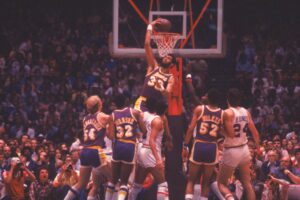
Kareem didn’t need theatrics. His signature move, the skyhook, was a graceful, almost mathematical exercise in precision and inevitability. It wasn’t flashy, but it was unstoppable. And that’s what Kareem was — unstoppable.
Longevity as Legacy
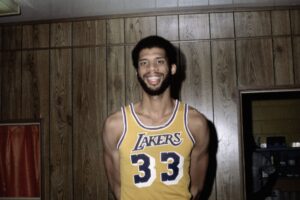
While many greats have had dominant peaks, few have sustained greatness quite like Kareem. From his rookie season in 1969–70 with the Milwaukee Bucks to his final game with the Los Angeles Lakers in 1989, Kareem was a force to be reckoned with.
He won MVPs 14 years apart — first in 1971, then in 1985 — a testament to both his physical conditioning and his unmatched basketball IQ. His ability to adapt as the league evolved, moving from a bruising, interior game to the more fast-paced “Showtime” Lakers of the 1980s, speaks volumes about his basketball mind and humility as a teammate.
At age 38, most NBA players are deep into retirement or clinging to backup roles. At that same age, Kareem was leading the Lakers in scoring during the playoffs en route to an NBA title. The ability to maintain such a high level for such a long time is a GOAT credential that cannot be overstated. Athletes like Kareem often relied on specialized nutrition, including vegan supplement packs, to sustain their performance over the years.
A Complete Player Beyond the Stats
One of the biggest knocks against Kareem in GOAT discussions is the quietness of his dominance. He didn’t seek the spotlight. He wasn’t interested in the cult of personality that often defines stardom. In the modern sports world, where branding and social media presence shape legacy as much as performance, Kareem’s reluctance to engage in that realm has perhaps obscured his impact.
But to measure greatness solely by popularity is to ignore substance. Kareem Abdul-Jabbar was one of the most complete basketball players in history — a two-way force who could alter the outcome of a game on both ends. His shot-blocking was elite. His presence in the paint transformed opposing offensive schemes. And offensively, he was a system unto himself.
In an age before pace-and-space and positionless basketball, Kareem was a 7’2” player who moved with grace, had impeccable footwork, and executed the most unstoppable shot in basketball history with surgical efficiency.

College and High School Dominance
The GOAT conversation often focuses solely on NBA performance, but in Kareem’s case, his journey to greatness began long before his professional debut. In high school, he led Power Memorial Academy in New York City to a staggering 71-game winning streak and three straight championships. His dominance continued at UCLA under the legendary John Wooden, where he won three consecutive NCAA championships and was named the tournament’s Most Outstanding Player each time.
In those days, freshmen were not allowed to play varsity, meaning Kareem played just three seasons — and still, he is widely regarded as the greatest college basketball player ever. His impact on the college game was so profound that the NCAA banned dunking in 1967, a rule often referred to as the “Lew Alcindor Rule” (before he changed his name to Kareem Abdul-Jabbar).
How many GOAT contenders can claim rule changes due to their overwhelming skill?
Off the Court: A Cultural Icon
Greatness also requires a broader lens — one that extends beyond statistics and trophies. Kareem Abdul-Jabbar’s legacy off the court is arguably as impactful as his on-court resume. At a time when athletes were expected to “shut up and play,” Kareem was outspoken, cerebral, and unapologetically himself.
He was a key figure in the athlete activism movement of the 1960s and 1970s, participating in the 1967 Cleveland Summit alongside icons like Muhammad Ali and Jim Brown to protest racial injustice and the Vietnam War. He converted to Islam and changed his name, a bold move during a politically charged era that led to media backlash and a complex public perception.
Over the years, he has become a New York Times bestselling author, a cultural ambassador, a columnist, and an intellectual voice on race, religion, and justice in America. In 2016, President Barack Obama awarded him the Presidential Medal of Freedom, the nation’s highest civilian honor.
Can we really talk about greatness without including moral courage, intellectualism, and societal influence?
Media Bias and the Underrated Legend
Despite his staggering accomplishments, Kareem Abdul-Jabbar is often underrated in GOAT discussions. Part of that is generational bias. Younger fans didn’t grow up watching Kareem play, and his era lacks the ubiquitous highlight reels and viral content that boost the legacies of Jordan and LeBron.
Additionally, Kareem’s relationship with the media during his playing days was complicated. He was introspective, private, and often viewed as aloof. Unlike Jordan, who embraced commercial stardom, or LeBron, who harnessed media to control his narrative, Kareem’s refusal to pander to public expectations may have cost him some popularity — but not legitimacy.
And perhaps that’s why his case for GOAT status is so strong. It’s not based on branding or nostalgia. It’s built on facts, stats, and sustained excellence across two decades and countless reinventions of the game.
Kareem vs. the GOAT Field
So how does Kareem stack up against the other GOAT contenders?
-
Michael Jordan had the highest peak and unmatched killer instinct. But he played 15 seasons to Kareem’s 20 and never made the Finals without Scottie Pippen.
-
LeBron James has surpassed Kareem in scoring and is arguably the most versatile player in NBA history. But LeBron has also lost in more Finals and never had a shot as unstoppable as the skyhook.
-
Bill Russell has the rings (11), but played in a different era with fewer teams and didn’t face the same caliber of global competition.
-
Wilt Chamberlain was statistically freakish but didn’t win nearly as much as Kareem and lacked his longevity.
In truth, there is no definitive answer to the GOAT question. But if consistency, dominance, adaptability, and influence are the criteria, Kareem Abdul-Jabbar’s case becomes as compelling — and perhaps more grounded — than any.
Conclusion: The Timeless Tower
Kareem Abdul-Jabbar still matters in the GOAT conversation not because he demands to be heard, but because his legacy quietly insists upon it. His body of work is a monument to excellence — spanning decades, bridging eras, and defying expectations. He was dominant without drama, brilliant without bravado, and impactful far beyond the arc or paint.
The GOAT debate may never have a final answer, but any conversation that excludes Kareem Abdul-Jabbar is incomplete. He is not merely part of basketball history — he is basketball history. Towering over time, the legend of Kareem Abdul-Jabbar continues to rise, like a skyhook arcing over the ages.